
Ontological Insecurity
The societal link between mental health problems and right-wing populism

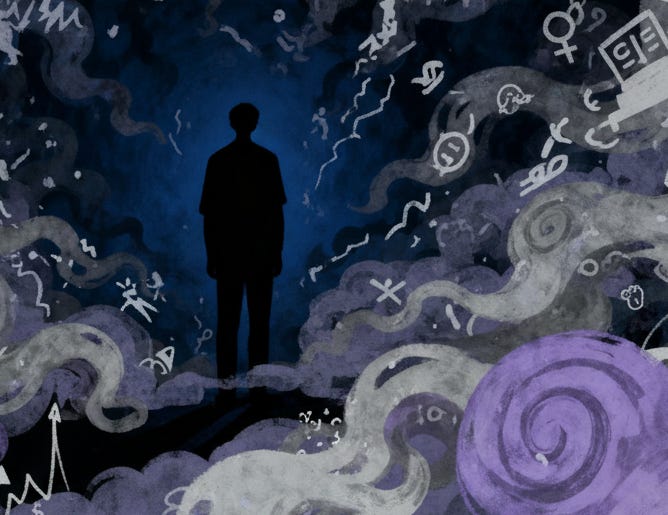
We live in what many scholars call a polycrisis: several crises unfolding at the same time and amplifying one another across social, economic, and political domains. Two visible symptoms are the rising demand for psychiatric and psychotherapeutic care and the electoral success of right‑wing populism. What—if anything—connects them?
This post argues that a shared emotional backdrop—ontological insecurity—helps explain both trends. By ontological insecurity I mean a deep, persistent uncertainty about who we are, how we belong, and whether the world around us is reliable. Importantly, this does not mean that people with mental health problems are more likely to vote for right‑wing or extrem‑right parties. The claim is more limited: similar insecurity issues can underlie different outcomes, from psychological distress to anti‑liberal political behavior.
Ontological insecurity – the psychiatric origins
The concept of ‘ontological security/insecurity’ comes from a scientific corner that may come as a surprise, namely from an attempt to develop a theory of schizophrenia. Scottish psychiatrist and psychoanalyst Ronald D. Laing developed this theory in his 1959 book “The Divided Self,” in which he takes a person’s relationship to their environment as the starting point for the question of who is at risk of becoming psychotic or schizophrenic [1]. According to Laing, ontological insecurity was the prerequisite for psychosis. An ontologically secure person, according to his definition, is someone who has a conception of themselves in the world as real, alive, and whole, and who remains the same person in a temporal sense. These are the conditions for being able to encounter the world and other people as equally real, alive, and whole. If this inner consistency and substance are lost, then the risk of schizophrenic development is increased, according to Laing’s interpretation.
Ontological insecurity – the social perspective
More than 30 years after the publication of R.D. Laing’s book, British sociologist Anthony Giddens revisited the terminology [2]. This time, the focus was not on schizophrenia or psychosis, but on human identity in modern society. According to this concept, ontological security corresponds to the ‘natural view’ of the world and of oneself; an ontologically secure person is at peace with themselves and the world. This ontologically secure person is ‘emotionally inoculated’, as Giddens puts it, they are not existentially vulnerable, and they have answers to the challenges of life in modern society.
Modern society does not make it easy for people to achieve and maintain this ontological security, according to Giddens. A key factor in this is the societal plurality and diversity. In contrast to earlier societies, there are now many more choices and also obligations to choose. We have much less guidance today regarding our life course and must decide important matters on our own, whereas in the past there were clearer restrictions imposed by the social milieu.
If we make the wrong decisions, for example with regard to education, career, or intimate relationships, this can have long-term negative consequences. Unfortunately, it is often only in hindsight that we realize which decisions were right and which were wrong. Anyone who fails to complete vocational training or university – ideally the right kind – or who has a child with a partner and then realizes that the partner is unwilling or unable to support the child after the relationship ends is likely to have a difficult time in the rest of their life—and so will the child.
However, it is not only individual developments that make it difficult for a person to achieve and maintain ontological security. It is not uncommon for social developments to cause a world to collapse, so to speak, and no longer be the same as it once was. It is, in a sense, fundamental to modern society that it is constantly changing and creating uncertainty. The Polish sociologist Zygmunt Bauman [3] once described this as the two fundamental beliefs of what he called ‘liquid modernity’. The first belief is that change is permanent, and the second is that uncertainty is the only certainty in modern society.
Social change, experiences of loss, and ontological insecurity
Sigmund Freud already noted human unease in modern culture in one of his most famous writings—at the time as a consequence of the renunciation of instinctual fulfillment due to the constraints of society [4]. The idea of unease subsequently runs through the entire social science literature. Unease develops particularly in connection with experiences of loss.
There are two forms of loss in modern society that contribute to ontological insecurity. The first form is cultural changes that are experienced as loss. It is therefore not surprising that sociological and historical research has identified the 1960s and 1970s as the decades in which the cultural struggles that continue to this day and have spread globally originated in the United States. American sociologist James Davison Hunter, who coined the term ‘culture war’, identified the expansion of education during this period as the main factor that, through the increasing economic and political influence of women, led to the undermining of previous ideas about social coexistence [5]. According to his analysis, the culture wars were about nothing less than the ‘power to define reality’.
It is important not to romanticize the time before this loss. It was a time when women (not only) in the global North had relatively little say, were hardly represented politically, and in many countries were not even allowed to have their own bank accounts. People with disabilities and mental health issues were made invisible by being cared for in care homes and asylums, where they were usually poorly looked after, and homosexuality was virtually non-existent. According to historian Andrew Hartman, the idea of a conservative and Christian-influenced “normative America” was shaken when groups of people who had previously been excluded from the mainstream made themselves politically visible [6]. The conservative right therefore describes the subsequent developments as the decline of the US – which was supposedly only halted by Trump and the MAGA movement.
The previous failure to represent these and other people and their perspectives was possibly the price to pay for a worldview that exhibited a certain consistency and coherence. And the loss of this worldview was then possibly the price to pay for questioning the only relevant cultural perspective of white heteronormative conservative men.
The second form of loss is material in nature. One of the fundamental problems associated with loss in today’s world is probably that it tends not to be expected, but rather that increasing progress and prosperity are associated with social development. The children’s generation should have it better than their parents’ generation. This material progress was called into question at the latest with the global financial crisis of 2007-2009. Many people lost not only the loans for their homes, but also their savings, and young people had considerable problems during this period in finding reasonably well-paid jobs after vocational training or university.
However, the financial crisis was only the tip of the iceberg of economic problems. Underneath, longer-term changes in globalized capitalism were becoming apparent. These include the relocation of jobs from traditional industrial centers to Asia or Latin America. In the United States, the fatal consequences of these shifts have become known as ‘deaths of despair’. These deaths of despair are particularly noticeable in certain regions in the form of suicides or opioid addiction. Economists Anne Case and Angus Deaton [7], who coined the term, describe this as a slow and long-term loss of a way of life that particularly affects less-educated white workers – and which in recent years has also affected people from other ethnic backgrounds.
Anthony Giddens already counted individual pride and basic trust among the fundamental conditions of ontological security. We now know that many people who die in despair have lost precisely these aspects. Above all, they have lost the pride in the way of life associated with their jobs, for example as (male) miners or steelworkers. For them, this way of life was, in a sense, without alternative. It guaranteed a relatively secure income for decades. In addition, workers in the United States often lived in fairly remote areas with poor transport links and few educational opportunities or other jobs.
In addition, according to sociologist Arlie Russel Hochschild, who conducted scientific research in these regions at various times before and during the Trump administration 1.0 [8, 9], the workers affected did not expect and could not expect any help from the state. The prevailing credo in large parts of American society was and still is that the state should stay out of economic matters. As a result, they had no confidence in institutions that were only rudimentary in the American welfare system anyway – and are even less pronounced under Trump 2.0.
The experiences of loss reflect a profound social change. At the same time, these experiences of loss coincide with the general liberalization of culture in modern societies. It doesn’t take much imagination to picture what an unemployed miner from a coal mining area thinks of post-materialistic ecological attitudes that tell him his job triggered the climate crisis and that his industry should be abolished. And it also takes no imagination to picture what he will think of new, female-dominated service jobs, for example in nursing. If he is also fundamentally conservative, then there is a high probability that he will vote against liberal positions in the wake of these developments.
The opioid crisis, deaths of despair, and the swing to right-wing and far-right political attitudes are empirically proven to be regionally associated [10, 11]. This does not necessarily mean that people with mental health problems are more likely to vote right-wing; however, it does mean that in regions where ontological insecurity is spreading rapidly, there is a tendency to increasingly take a stand against liberal positions.
Ontological insecurity and threatened identities
The experiences of loss and their consequences suggest that the people affected often feel that their identity is under threat. These identities relate both to social status (income, prestige, etc.) and to belonging to a particular group (ethnicity, nation, etc.). It is not uncommon for these processes to combine to form a general threat to individual and social identity.
According to recent research on ontological insecurity, these threatened identities can also be attached to ‘material’ things such as certain landscapes or national borders [12]. In this way, physical boundaries can mark a ‘body’ that can be secured but also threatened. This perspective allows for a better understanding of the social and emotional consequences that have arisen, for example, in connection with the large migration movements in Europe and the US in the 2010s. While many people have developed a positive culture of welcome or at least an accepting attitude over a long period of time, others have increasingly experienced a loss of sovereignty. According to research, such a loss of sovereignty arises in particular when the perceived homogeneity of a state or society is felt to be under threat. Such experiences can be exacerbated when the social environment is perceived as unstable, for example due to economic developments such as financial crises or recessions.
The concept of ontological insecurity also allows us to better understand the effects of state or territorial losses beyond the drawing of borders. In line with this perspective, Ukraine and Kosovo played and continue to play a fundamental role in the national imaginations of Russia and Serbia, for example. The loss of these territories has triggered considerable ontological uncertainties. Therefore, territorial losses have immense mobilization potential. This can in no way serve as a legitimate justification for warlike or subversive actions, but it can make the seemingly widespread public support for the military actions by Russian or Serbian forces politically and emotionally understandable, without excusing the subsequent aggressive acts.
Another source of potential uncertainty, particularly in relation to the ‘nation’, is the gender issue. The liberalization of cultural values has, as is well known, led to a significant revaluation of women in the social fabric and is perceived by many men as a threat or at least as a source of uncertainty. This uncertainty plays out, for example, in interactions with the opposite sex (what is still acceptable when flirting or dating?) or in language (what can still be said?). Ultimately, masculinity is often criticized in public and classified as ‘toxic’. It is therefore hardly surprising that anti-liberal and nationalist movements from Hungary to India to the US are adopting anti-feminist positions or portraying their leaders as ‘strongmen’ and allowing them to act accordingly [13, 14]. In this way, feminists are just as much ‘enemies of the people’ as members of the LGBT community and other groups.
In the present day, many aspects come together that challenge or undermine stable identities and ontological certainties. Since the beginning of the 21st century, crises have followed one after another, from 9/11 to the financial crisis and the pandemic to the war against Ukraine. At the same time, a significant cultural change is taking place that undermines old certainties of national or gender identities.
Conclusions: Ontological insecurity as a trigger for mental health problems and anti-liberal politics
Ontological insecurity can be understood as the central emotional trigger for both mental health problems and anti-liberal attitudes, voting behavior, and political activities.
Both issues can occur in the same regions, but this is not necessarily the case. What they have in common, however, is the emotional background that contributes to the experience of crisis. Politics in recent years has increasingly thrived on generating such emotions, but also on absorbing certain feelings from the population. As sociologist Eva Illouz has shown using the example of Israel, these feelings of ‘being left behind’ as well as uncertainties and fears of a general nature are channeled by political actors for their own ends and transformed into resentment [15].
The uncertainties are based on long-term sociocultural developments, but also on concrete experiences of crisis. They form the foundation for the promise of supposed security and nostalgia, which is supposed to lead away from a present that is experienced as dangerous and constructed as dangerous. In the end, the “good” people stand against the elites, who are described as selfish and corrupt and who are declared enemies, just like certain countries that want to enrich themselves economically [16]. They ‘enrich’ themselves, for example, by producing trade deficits – which are completely normal in the real economy and have virtually no impact on a country’s prosperity. One need only recall Trump’s abstruse statements that the EU was founded solely to weaken the US economically. The associated claims and ‘facts’ cannot be verified by fact checks. However, this plays just as little a role in anti-liberal rhetoric as it does in actual politics. The ontological insecurity in the current polycrisis strives for perceived security, which is – supposedly – created by strongmen in authoritarian politics.
References
1. Laing, R.D., The Divided Self: An Existential Study in Sanity and Modernity. 1990, London: Penguin.
2. Giddens, A., Modernity and self-identity: Self and society in the late modern age. 1991, Cambridge: Polity.
3. Bauman, Z., Liquid Modernity. 2012, Cambridge, Engl.: Polity.
4. Freud, S., Civilization and Its Discontents. 1961, New York: W.W. Norton.
5. Hunter, J.D., Culture Wars: The Struggle to Define America. 1991, New York: Basic Books.
6. Hartman, A., A war for the soul of America: A history of the culture wars. 2019, Chicago: University of Chicago Press.
7. Case, A. and A. Deaton, Deaths of Despair - And the Future of Capitalism. 2020, Princeton: Princeton UP.
8. Hochschild, A.R., Strangers in their own land: Anger and mourning on the American right. 2018, New York: The New Press.
9. Hochschild, A.R., Stolen Pride: Loss, Shame, and the Rise of the Right. 2024, New York: The New Press.
10. Arteaga, C. and V. Barone, Republican Support and Economic Hardship: The Enduring Effects Of the Opioid Epidemic. The Quarterly Journal of Economics, 2025.
11. Siegal, N., Exposure to Deaths of Despair and US Presidential Elections. Available at SSRN 4808858, 2025.
12. Krickel-Choi, N.C., The embodied state: why and how physical security matters for ontological security. Journal of International Relations and Development, 2022. 25(1): p. 159-181.
13. Kinnvall, C. and C. Agius, Ontological insecurity and the gendered postcolonial subject, in Handbook on Gender and Security, J. Joachim, A. Kronseil, and N. Dalmer, Editors. 2025, Edward Elgar Publishing. p. 37-48.
14. Dutta, S. and T. Abbas, Protecting the people: populism and masculine security in India and Hungary. Journal of Political Ideologies, 2025. 30(2): p. 517-539.
15. Illouz, E., The Emotional Life of Populism. 2023, Cambridge, Engl.: Polity Press.
16. Homolar, A. and R. Scholz, The power of Trump-speak: populist crisis narratives and ontological security. Cambridge Review of International Affairs, 2019. 32(3): p. 344-364.